
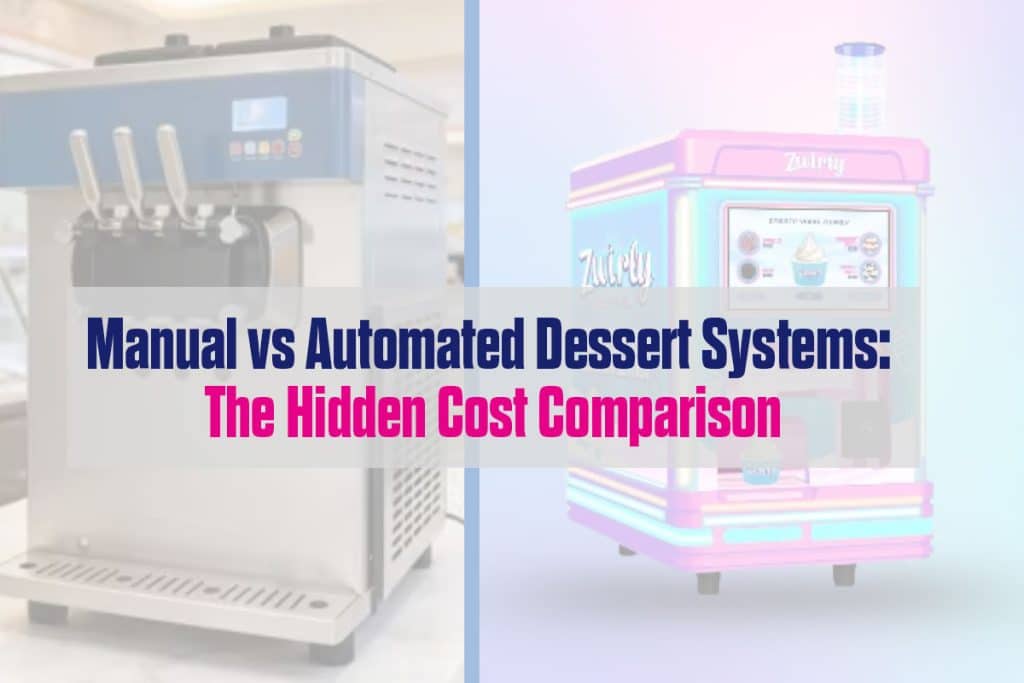
The real cost of dessert isn’t what most operators think.
It’s not just equipment.
It’s execution.
Manual dessert systems: the hidden expenses
Traditional soft-serve programs include:
Labor costs
Training requirements
Cleaning oversight
Operational downtime
These costs accumulate quickly, especially when relying on manual dessert systems that depend on consistent staff execution.
A simple comparison
Manual systems:
- Labor-dependent
- Inconsistent availability
- Variable portion control
- Operational risk
Zwirly:
- Fully automated
- Consistent output
- Always available
- Minimal oversight
The financial difference
Manual systems:
- Higher labor costs
- Lower reliability
- Reduced margins
Zwirly:
- $4.50–$5.00 profit per sale
- Up to ~80% margins
- No incremental labor
This is why many operators are shifting toward an automated dessert system that reduces labor exposure and improves consistency.
The structural shift
Operators are not just upgrading equipment.
They are replacing:
Labor-dependent execution with Autonomous infrastructure, enabling a labor-free dessert program that operates independently of staffing constraints.
Summary
The difference between manual and automated systems is not incremental.
It is structural.
Zwirly delivers a fundamentally stronger economic model.