
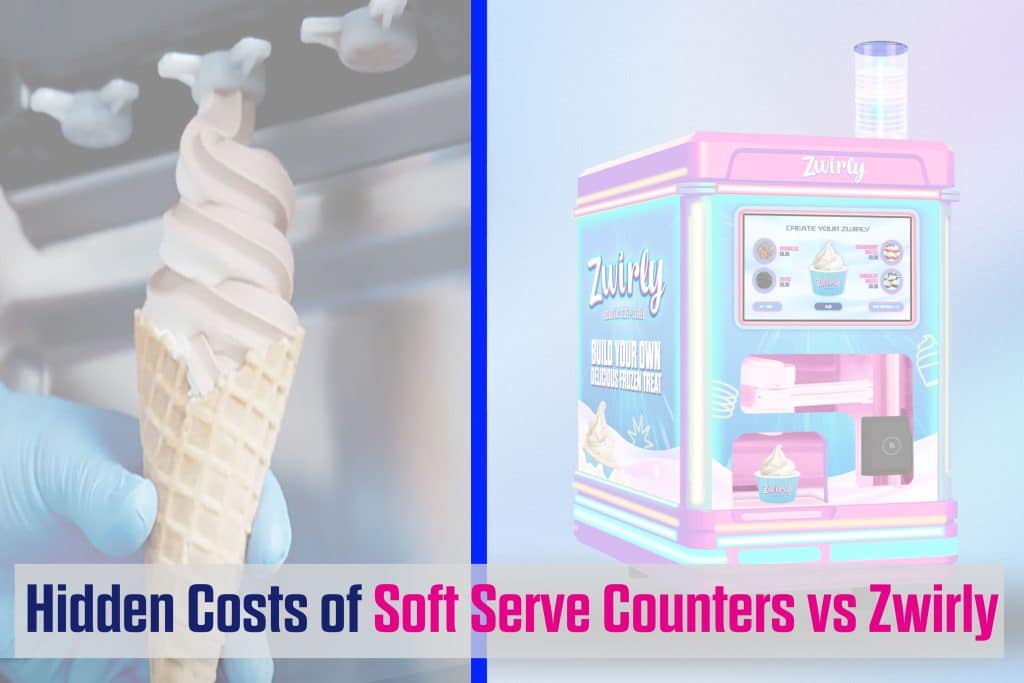
At first glance, traditional soft serve counters appear to be a straightforward way to add dessert sales. The equipment is familiar, customers recognize it, and the concept feels proven. However, once operators look beyond the initial purchase price, hidden costs quickly emerge. Labor, space, maintenance, and operational friction often reduce profitability over time.
This article breaks down the true cost differences between traditional soft serve counters and modern automated alternatives, highlighting why many operators are rethinking their approach.
Why the True Cost of Soft Serve is Often Misunderstood
Most cost comparisons focus on equipment price alone. In reality, long-term profitability depends on everything required to keep a soft serve program running day after day.
Traditional soft serve counters typically involve:
- Dedicated staff time
- Manual cleaning and maintenance
- Inconsistent portion control
- Space and workflow constraints
These ongoing factors quietly compound into significant operational costs.
Labor Costs That Add Up Over Time
Labor is one of the largest hidden expenses tied to traditional soft serve counters. Staff are required for:
- Serving and supervision
- Cleaning and sanitization
- Shift coverage during peak hours
- Training and turnover replacement
Even when soft serve sales are strong, labor dependency can erode margins. This is where automation becomes attractive, as it removes daily staffing requirements and reduces payroll exposure.
Space and Workflow Inefficiencies
Soft serve counters often demand more space than expected. Beyond the machine itself, operators must account for:
- Clearance for staff operation
- Back-of-house prep and storage
- Disruption to existing workflows
By contrast, automated systems are designed to fit within tight layouts, making them more practical for locations where counter space directly impacts revenue potential.
For many operators, switching to an automated countertop soft serve solution allows them to replace staff-dependent counters with a compact system that fits seamlessly into existing layouts.
Maintenance, Downtime, and Consistency Issues
Traditional counters rely heavily on manual processes. Cleaning cycles, refills, and troubleshooting all depend on staff availability and consistency. This can lead to:
- Downtime during busy periods
- Variations in product quality
- Increased maintenance calls
Automated systems reduce these risks by standardizing operations and minimizing human error.
ROI Comparison: Traditional Counters vs Automation
When operators evaluate a pricing and ROI comparison, the difference becomes clear. Traditional soft serve counters may generate revenue, but their margins are reduced by:
- Ongoing labor expenses
- Higher maintenance involvement
- Inconsistent operating hours
Automation improves ROI by:
- Eliminating labor from the serving process
- Delivering consistent portions
- Operating unattended during peak and off-peak hours
Over time, these efficiencies often result in faster payback and more predictable returns.
Requirements and Operational Complexity
Traditional soft serve counters frequently require:
- Plumbing and drainage
- Health permits and inspections
- Staff training and oversight
Automated alternatives simplify requirements with:
- Countertop placement
- Standard power access
- Cloud-based monitoring
This difference significantly lowers the barrier to entry for many businesses.
Frequently Asked Questions
1. What hidden costs make traditional soft serve counters less profitable over time?
Labor, manual cleaning, inconsistent portions, and downtime quietly reduce margins beyond the initial equipment cost.
2. Why do automated systems scale better than staff-operated soft serve counters?
Automation removes staffing variability, making performance consistent and repeatable across locations.
3. How does automation reduce operational risk compared to traditional counters?
Automated systems standardize serving, cleaning, and monitoring, reducing human error and compliance issues.
4. Which business types benefit most from replacing soft serve counters with automation?
Labor-sensitive and space-limited environments like convenience stores, QSRs, hotels, and cafés.
5. How does automation improve ROI predictability?
By operating unattended with fixed costs, automation delivers steadier daily output and more reliable returns.
Summary
Traditional soft serve counters come with hidden costs that impact long-term profitability especially labor, space, and operational complexity. Automation offers a more efficient alternative by simplifying operations and stabilizing margins. Zwirly demonstrates how replacing staff-dependent counters with an automated dessert solution can reduce overhead, improve consistency, and deliver stronger, more predictable ROI for modern foodservice and retail environments.